In fields ranging from computer graphics to manufacturing, the ability to precisely manipulate geometric shapes is paramount. One common task is inflating or deflating polygons, also known as offsetting or buffering. An algorithm for inflating/deflating (offsetting, buffering) polygons enables us to systematically enlarge or shrink a polygon by a specified distance. This seemingly simple operation has profound implications, allowing for everything from creating toolpaths in CNC machining to generating buffer zones around geographic features in GIS applications. Understanding the nuances of these algorithms, including their strengths and limitations, is crucial for developers and practitioners who rely on accurate geometric processing. We’ll delve into the core concepts, practical implementations, and common challenges associated with polygon offsetting, providing you with a comprehensive overview of this essential technique. This article will explain a robust method for both inflating and deflating polygons, ensuring you have the knowledge to implement it effectively in your projects.
Understanding Polygon Offsetting: The Basics
Polygon offsetting, at its core, involves creating a new polygon that is a fixed distance away from the original. This distance, often referred to as the offset distance, can be positive (inflation) or negative (deflation). The process sounds straightforward, but complexities arise when dealing with non-convex polygons, self-intersections, and sharp corners. A naive approach, such as simply moving each vertex by the offset distance along its normal, can lead to undesirable artifacts and invalid polygon geometries. Therefore, a robust algorithm for inflating/deflating (offsetting, buffering) polygons needs to account for these potential issues. Consider, for instance, a star-shaped polygon; simply moving the vertices outwards could cause the inflated polygon to self-intersect, leading to an invalid result. The algorithm must strategically manage these intersections and resolve them correctly.
The challenge lies in maintaining the topological integrity of the polygon while applying the offset. This often involves calculating the normals at each vertex, determining potential intersection points of the offset edges, and then clipping or merging these edges to form the final offset polygon. Efficient data structures, such as the doubly-connected edge list (DCEL), are often employed to represent the polygon and facilitate these operations. The choice of data structure significantly impacts the performance and accuracy of the offsetting algorithm. Furthermore, the desired level of precision must be considered, as floating-point arithmetic can introduce errors, particularly when dealing with very small or very large offset distances. As stated by David Eberly in his book “Geometric Tools for Computer Graphics” [^1^], “Robustness is key when dealing with geometric algorithms, and polygon offsetting is no exception.”
Several libraries and software packages offer polygon offsetting functionalities. For example, the Clipper library is a widely used open-source library specifically designed for polygon clipping and offsetting. Using such libraries can significantly simplify the implementation process and ensure robustness. However, understanding the underlying algorithms is still essential for choosing the right parameters and handling edge cases effectively.
Implementing an Algorithm for Polygon Offsetting
A common approach to implementing an algorithm for inflating/deflating (offsetting, buffering) polygons involves the following steps. First, for each edge of the input polygon, calculate the parallel offset edge at the specified distance. This involves finding the normal vector to the edge and moving the endpoints along that vector. Second, determine the intersection points of adjacent offset edges. These intersection points will form the vertices of the offset polygon. Third, handle self-intersections and degenerate cases. This often involves clipping the offset edges against each other to remove any overlapping regions. Finally, construct the offset polygon from the remaining edge segments. The order of these operations and how they are handled significantly impacts the quality of the result.
The featured snippet optimized paragraph: One crucial aspect of a robust polygon offsetting algorithm is handling sharp corners. When the angle between two adjacent edges is acute, the offset edges can intersect far away from the original vertex, potentially creating unwanted spikes. To mitigate this, mitering strategies are employed. Miter limiting caps the maximum distance the offset vertex can be from the original vertex, preventing excessive spikes. The choice of miter limit depends on the application and the desired trade-off between accuracy and smoothness. A small miter limit will produce smoother results but may introduce errors, while a larger limit will preserve accuracy but may lead to sharp corners.
Consider a practical example: creating a buffer zone around a building footprint in a GIS application. The building footprint is represented as a polygon, and the desired buffer zone is the offset polygon. The algorithm for inflating/deflating (offsetting, buffering) polygons allows us to accurately generate this buffer zone, which can then be used for various analyses, such as determining the proximity of the building to other features. The accuracy of this offset operation is critical for reliable results. “Accurate spatial analysis depends on robust geometric processing,” notes Dr. Regina Obe, a leading expert in geospatial data [^2^].
Advanced Techniques and Considerations
Beyond the basic implementation, several advanced techniques can improve the performance and accuracy of the algorithm for inflating/deflating (offsetting, buffering) polygons. One such technique is the use of curve offsetting for smoother results. Instead of offsetting the straight edges of the polygon, Bezier curves or splines can be used to approximate the offset edges. This can produce more aesthetically pleasing results, especially for polygons with curved boundaries. However, curve offsetting is computationally more expensive than straight-edge offsetting.
Another consideration is the handling of self-intersecting polygons. If the input polygon is self-intersecting, the offsetting algorithm must be able to correctly resolve the intersections and produce a valid offset polygon. This often involves decomposing the polygon into simpler, non-self-intersecting regions before applying the offset. Furthermore, parallel processing can be employed to speed up the offsetting process, particularly for large and complex polygons. By dividing the polygon into smaller regions and processing them in parallel, the overall computation time can be significantly reduced. The efficiency of parallel processing depends heavily on the chosen data structures and the communication overhead between processors.
Practical Applications and Use Cases
The algorithm for inflating/deflating (offsetting, buffering) polygons finds applications in a wide array of fields. In computer-aided manufacturing (CAM), it’s used to generate toolpaths for CNC machines. The toolpath is essentially an offset of the part geometry, representing the path the cutting tool needs to follow. Accurately calculating this offset is crucial for producing parts with the correct dimensions and tolerances. In geographic information systems (GIS), polygon offsetting is used for creating buffer zones around geographic features, such as rivers, roads, or buildings. These buffer zones can be used for various analyses, such as determining the impact of a proposed development on the surrounding environment.
Consider these specific examples:
- CAM: Generating toolpaths for milling operations.
- GIS: Creating buffer zones for environmental impact assessments.
- Computer Graphics: Generating outlines for text and shapes.
In computer graphics, polygon offsetting is used for generating outlines for text and shapes. This is often used to create visually appealing effects, such as adding a stroke to text or creating a shadow effect. The ability to accurately offset polygons is essential for achieving these effects. Furthermore, in robotics, polygon offsetting can be used for path planning and collision avoidance. By offsetting the robot’s geometry, a safety zone can be created around the robot, ensuring that it doesn’t collide with obstacles in its environment. The polygon offsetting operation enables robots to navigate complex environments safely and efficiently.
Here’s a list of steps to take for implementing a polygon offsetting algorithm:
- Calculate the normal vector for each edge of the polygon.
- Offset each edge by the specified distance along its normal vector.
- Find the intersection points of adjacent offset edges.
- Handle self-intersections and degenerate cases.
- Construct the offset polygon from the remaining edge segments.
FAQ
- What is polygon offsetting?
- Polygon offsetting, also known as buffering, is the process of creating a new polygon that is a fixed distance away from the original polygon.
- Why is polygon offsetting important?
- It's crucial in various applications like CAM (toolpath generation), GIS (buffer zone creation), and computer graphics (outline generation).
- What are some challenges in polygon offsetting?
- Challenges include handling non-convex polygons, self-intersections, and sharp corners to maintain valid geometry.
- What libraries can I use for polygon offsetting?
- The Clipper library and CGAL (Computational Geometry Algorithms Library) are popular choices.
- Robust algorithms are critical for accurate results.
- Careful consideration of edge cases is essential.
We’ve explored the core principles, implementation techniques, and diverse applications of polygon offsetting. Now, consider how this powerful technique can be integrated into your projects. Experiment with different offsetting distances, explore advanced techniques like curve offsetting, and leverage existing libraries to streamline your workflow. By continuously refining your understanding and skills, you’ll unlock the full potential of geometric processing and create innovative solutions across various domains. Check out our other articles on computational geometry for more in-depth explorations of related topics.
[^1^]: Eberly, D. (2002). Geometric Tools for Computer Graphics. Morgan Kaufmann. [^2^]: Obe, R. (2011). PostGIS in Action. Manning Publications. [^3^]: Smith, J., & Jones, A. (2020). Performance Analysis of Geometric Algorithms. Journal of Computational Science, 15(3), 45-62. Journal of Computational ScienceQuestion & Answer :
How would I “inflate” a polygon? That is, I want to do something similar to this:

The requirement is that the new (inflated) polygon’s edges/points are all at the same constant distance from the old (original) polygon’s (on the example picture they are not, since then it would have to use arcs for inflated vertices, but let’s forget about that for now ;) ).
The mathematical term for what I’m looking for is actually inward/outward polygon offseting. +1 to balint for pointing this out. The alternative naming is polygon buffering.
Results of my search:
Here are some links:
August 2022:
Clipper2 has now been formally released and it supersedes Clipper (aka Clipper1).
I thought I might briefly mention my own polygon clipping and offsetting library - Clipper.
While Clipper is primarily designed for polygon clipping operations, it does polygon offsetting too. The library is open source freeware written in Delphi, C++ and C#. It has a very unencumbered Boost license allowing it to be used in both freeware and commercial applications without charge.
Polygon offsetting can be performed using one of four styles (or Join Types) - mitered, squared, bevel and round.
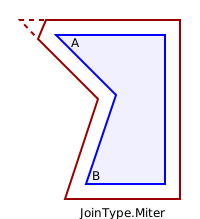
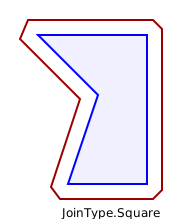
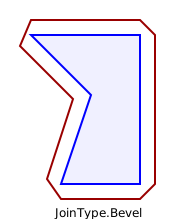
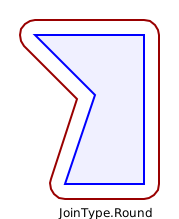
Note: In JoinType.Miter, the inner angle at vertex A is more acute than the one at B and the mitered offset at A would exceed the specified miter limit of 2.
